New Delhi: India’s first space-based solar observatory, Aditya L1, has helped scientists study the nature of expansion of a solar eruption, or coronal mass ejection (CME), revealing new insights that could be important for space-weather studies and their potential impact on satellites and communication networks.
The Aditya L1 satellite, launched in September 2023, is now operational at the Sun–Earth L1 point, providing continuous observations of the Sun.
It carries seven payloads, including the Visible Emission Line Coronagraph (VELC), its primary payload. VELC is an internally occulted coronagraph designed to observe the solar corona simultaneously in various modes.
By combining data from the Visible Emission Line Coronagraph on Aditya L1 with complementary observations from NASA’s Solar Dynamics Observatory (SDO) and three-dimensional modelling, scientists from the Indian Institute of Astrophysics (IIA), an autonomous institution of the Department of Science and Technology (DST), were able to reconstruct the full 3-D geometry and dynamics of solar eruptions.
Their study, published in The Astrophysical Journal Letters, showed for the first time that the CME did not expand outward from the Sun like a simple symmetric bubble, as previously thought.
Instead, it underwent non-uniform expansion and developed an asymmetric shape.
These differences in CME expansion can affect its speed as it travels towards Earth, potentially causing space-weather disturbances.
The observations from Aditya L1 therefore provide new information about how CMEs evolve in the early stages of their propagation.
Aditya L1 VELC Captures Solar Eruption
The VELC on Aditya L1 studies nascent CMEs through spectroscopy in the 530.3 nm wavelength green emission line, caused by highly ionized iron atoms in the corona.
This line emission captures hot coronal plasma at temperatures of around 1.8 million Kelvin.
The Doppler shift, or the change in the wavelength of this emission line, provides information about plasma velocity along the line of sight and close to the solar disk.
The VELC, with this unique capability, was designed and fabricated by the IIA at its MGK Menon Lab for Space Sciences on the CREST campus in Hosakote, with substantial support from ISRO.
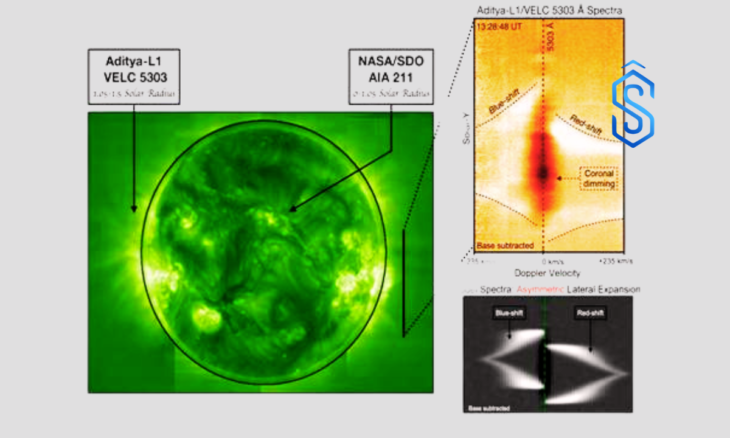
“We observed the CME that occurred on 5 August 2024 using the VELC as well as data from the Atmospheric Imaging Assembly (AIA) onboard NASA’s Solar Dynamics Observatory (SDO)”, explained Saurabh Tripathi, a PhD student at IIA and lead author of the study.
The CME was launched from an active region near the western limb of the Sun.
VELC’s spectroscopic data showed an unusual yet distinct Doppler pattern of blueward- and redward-shifted emission, which arises from plasma moving towards and away from us, respectively.
Aditya L1 Data Shows CME Did Not Expand Uniformly
“Our results show that the CME did not expand uniformly. The AIA images captured how the CME propagated across the sky, while VELC revealed the motion of the expanding CME bubble towards and away from us,” Tanmoy Samanta, a solar astronomer at IIA and the corresponding author of the study, elaborated.
Together, observations from Aditya L1 and NASA’s SDO revealed that the CME did not expand like a simple spherical bubble. Instead, its uneven expansion caused it to develop an asymmetric shape.
The findings provide a more detailed view of CME behaviour in the inner solar corona, where these eruptions evolve rapidly.
3-D Model Helps Explain Aditya L1 VELC Observations
“To understand the unusual spectral pattern observed by VELC, we then developed a 3-D geometric-kinematic model of an expanding CME”, said Jayant Joshi of IIA and a co-author.
The model was used to test how the CME’s orientation and uneven sideways expansion could produce the spectral structures observed by VELC on Aditya L1.
A model with symmetric expansion could not reproduce the observed pattern. Instead, a model featuring an inclined CME axis and asymmetric lateral expansion produced a spectral pattern and temporal evolution similar to those observed by VELC.
The researchers plan to use this technique on other CMEs to reconstruct their motion without relying entirely on multi-viewpoint imaging from telescopes in space.
This complementarity is particularly valuable in the lower corona, where CMEs evolve rapidly and their motion along the line of sight cannot be obtained from imaging alone.
Aditya L1 Findings Could Help Space Weather Studies
The study also highlights the potential significance of the asymmetric shape of an early CME for its subsequent propagation through the heliosphere.
“The asymmetric shape of an early CME can have important implications for how it interacts with the solar wind and experiences drag during its propagation through the heliosphere. Such effects can influence the CME’s speed and, ultimately, its arrival time at Earth”, said Joshi.
The findings from Aditya L1 and VELC provide scientists with a way to study the three-dimensional motion and expansion of solar eruptions using spectroscopic observations combined with imaging and modelling.
The study focused on the CME observed on 5 August 2024 and used VELC observations from Aditya L1, data from NASA’s SDO/AIA and a 3-D geometric-kinematic model to identify the asymmetric lateral expansion of the CME in the inner corona.
Publication: 10.3847/2041-8213/aea295